
STEAM education is changing the way students learn by connecting science, technology, engineering, arts, and math into one powerful approach. Most people expect subjects to be taught in separate silos, but this method flips the old rulebook. Research from Oregon shows students who learn this way develop complex cognitive skills that help them tackle real-world problems with creativity and critical thinking. The real surprise is that hands-on creativity is just as important as technical know-how, making this more than just another buzzword in classrooms.
Table of Contents
- Defining Steam Education: An Integrated Approach
- The Importance of Steam Education in Today’s World
- Exploring the Key Components of Steam Education
- How Steam Education Facilitates Critical Thinking
- Real-World Applications and Benefits of Steam Education
Quick Summary
| Takeaway | Explanation |
|---|---|
| STEAM fosters interdisciplinary problem-solving. | Students learn to integrate knowledge across multiple domains, enhancing their ability to tackle complex challenges creatively. |
| Critical thinking is essential in STEAM education. | The approach promotes skills such as analysis, evaluation, and innovation, preparing students for unpredictable future scenarios. |
| Real-world applications enhance learning relevance. | STEAM connects academic subjects to practical experiences, equipping students with relevant skills for future careers and global challenges. |
| Creativity is as important as technical skills. | The integration of arts fosters innovative thinking, ensuring students approach problems with imagination and emotional intelligence. |
| STEAM prepares students for evolving job markets. | By developing adaptable problem-solving skills, STEAM education equips learners for careers that require interdisciplinary thinking and collaboration. |
Defining STEAM Education: An Integrated Approach
STEAM education represents a transformative educational framework that goes beyond traditional subject boundaries, creating a dynamic learning environment where science, technology, engineering, arts, and mathematics converge. Unlike conventional teaching methods, STEAM education emphasizes interconnectedness and holistic problem solving.
This table compares conventional education approaches with STEAM education, highlighting their major differences and showing why STEAM is considered a more holistic framework.
| Approach | Subject Treatment | Problem Solving Style | Skills Emphasized | Role of Creativity |
|---|---|---|---|---|
| Conventional Education | Taught in isolated silos | Single-discipline focus | Rote knowledge, recall | Limited, often separated from STEM |
| STEAM Education | Integrated, interdisciplinary learning | Holistic, real-world | Critical thinking, adaptation | Central, fused with technical problem solving |
The Core Philosophy of Interdisciplinary Learning
At its heart, STEAM education recognizes that real world challenges cannot be solved through isolated disciplinary approaches. By integrating multiple domains, students develop complex cognitive skills that mirror professional problem solving strategies. According to research from Oregon’s education department, this approach prepares learners to tackle multifaceted challenges with creativity and critical thinking.
Key characteristics of STEAM education include:
- Promoting collaborative learning experiences
- Encouraging experimental and hands-on problem solving
- Developing adaptive thinking skills
- Nurturing creativity alongside technical proficiency
Bridging Academic Disciplines and Real World Application
STEAM education transforms traditional learning by creating meaningful connections between academic concepts and practical applications. Students no longer view subjects as disconnected academic exercises but as integrated tools for understanding and improving our world. Learn more about our innovative curriculum enrichment approach that supports this educational philosophy.
The approach recognizes that innovation rarely happens within rigid disciplinary boundaries. By encouraging students to explore intersections between art, science, technology, engineering, and mathematics, STEAM education cultivates a more nuanced understanding of complex systems and challenges. This method prepares students not just academically, but as future innovators capable of thinking across traditional academic constraints.
The Importance of STEAM Education in Today’s World
In an increasingly complex and technology-driven global landscape, STEAM education has become crucial for preparing students to navigate and excel in future careers. This educational approach equips learners with essential skills that extend far beyond traditional academic boundaries, developing adaptable problem solvers who can address multifaceted challenges.
Preparing Students for an Evolving Job Market
The modern workforce demands professionals who can think critically, collaborate effectively, and apply knowledge across multiple disciplines. Learn more about our STEM assembly programs that support this educational transformation. According to research from the Oregon Department of Education, STEAM education plays a pivotal role in preparing students for high-demand careers that require interdisciplinary thinking.
Key advantages of STEAM education include:
- Developing adaptable cognitive skills
- Fostering innovation and creative problem solving
- Encouraging cross disciplinary collaboration
- Building technological literacy
Addressing Global Challenges Through Integrated Learning
Global challenges like climate change, technological disruption, and healthcare innovations require holistic approaches that cannot be solved through single disciplinary perspectives. STEAM education trains students to view complex problems from multiple angles, integrating scientific understanding, technological innovation, engineering solutions, artistic creativity, and mathematical precision.
By nurturing comprehensive thinking skills, STEAM education empowers students to become proactive learners who can design innovative solutions to unprecedented challenges. This approach transforms education from passive knowledge acquisition to active, meaningful engagement with real world problems, ultimately preparing students not just for existing careers but for careers that have not yet been imagined.
Exploring the Key Components of STEAM Education
STEAM education represents a comprehensive framework where five critical disciplines converge to create a holistic learning experience. Understanding each component and their interconnectedness provides insight into this transformative educational approach.
Below is a table summarizing the key characteristics of each component of STEAM education to clarify their distinct roles and contributions within the integrated framework.
| Component | Description | Skills/Outcomes Developed |
|---|---|---|
| Science | Empirical observation and scientific inquiry | Systematic problem solving, experimentation |
| Technology | Application of digital tools and technological systems | Digital literacy, computational thinking |
| Engineering | Design and construction of functional solutions | Prototyping, spatial reasoning |
| Arts | Creative expression and design thinking | Imagination, communication, emotional intelligence |
| Mathematics | Analytical modeling and quantitative reasoning | Mathematical precision, modeling |
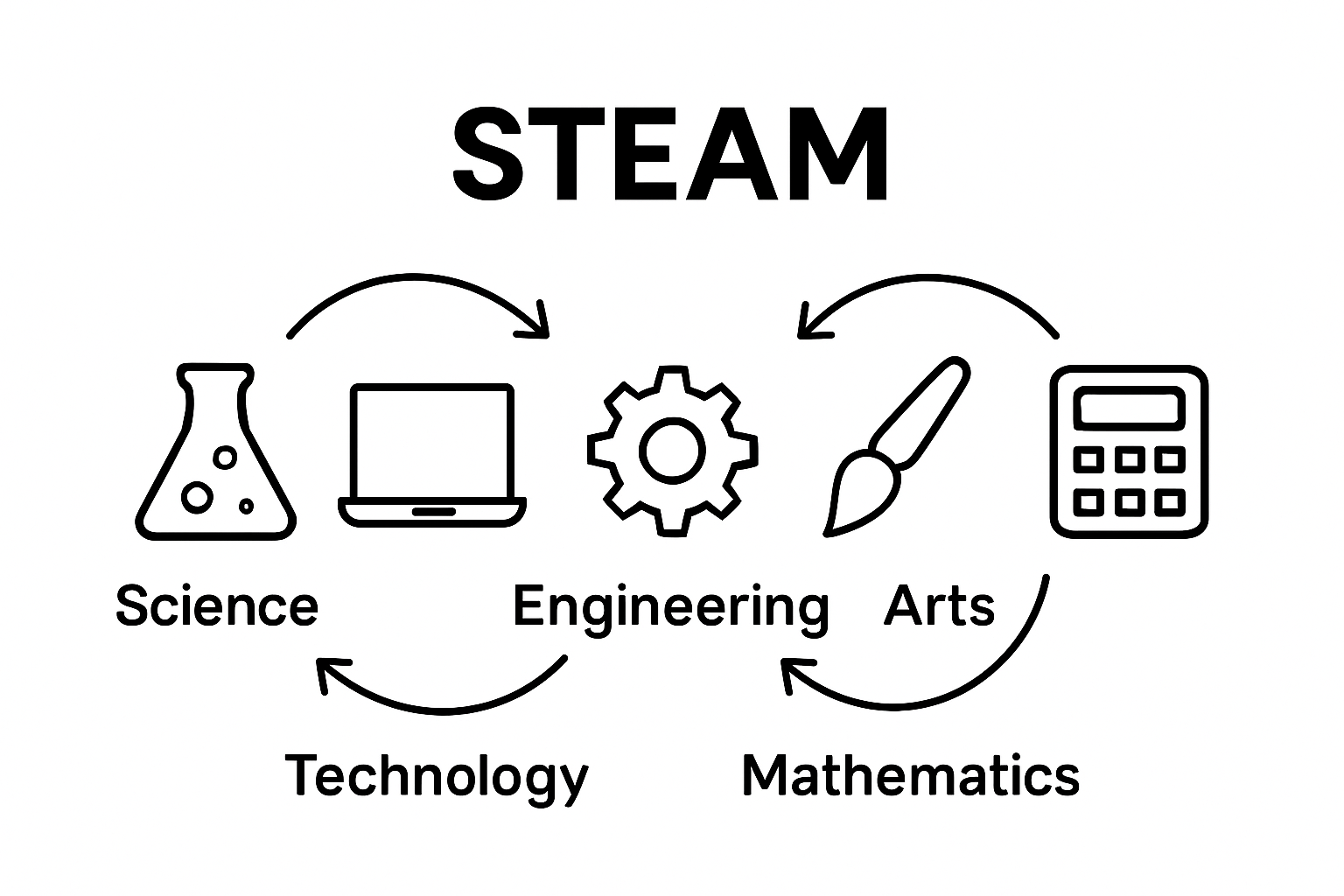
Science and Technology: The Foundational Elements
Science and technology form the core investigative and innovative pillars of STEAM education. These disciplines emphasize empirical observation, data analysis, and technological understanding. Learn more about our STEM education approach that supports these foundational skills. According to research from the International Society for Technology in Education, integrating science and technology helps students develop critical computational thinking skills and understand complex systemic interactions.
Key technological and scientific skills developed include:
- Systematic problem solving
- Data collection and analysis
- Digital literacy
- Scientific inquiry and experimentation
Engineering and Mathematics: Designing Innovative Solutions
Engineering and mathematics provide the structural and analytical backbone of STEAM education. These disciplines teach students how to design, model, and quantify solutions to real world challenges. By combining mathematical precision with engineering design principles, students learn to transform abstract concepts into practical applications.
The integration of engineering and mathematics encourages students to:
- Develop spatial reasoning skills
- Create mathematical models
- Apply geometric principles
- Design functional prototypes
Arts: The Creative Catalyst in STEAM Learning
Arts represent the creative catalyst that distinguishes STEAM from traditional STEM approaches. By integrating artistic thinking, students learn to approach problems with creativity, imagination, and aesthetic sensitivity. This component ensures that technical skills are balanced with innovative design thinking, communication, and emotional intelligence.
The arts transform technical learning by introducing elements of visual representation, creative problem solving, and expressive communication that make complex concepts more accessible and engaging.
How STEAM Education Facilitates Critical Thinking
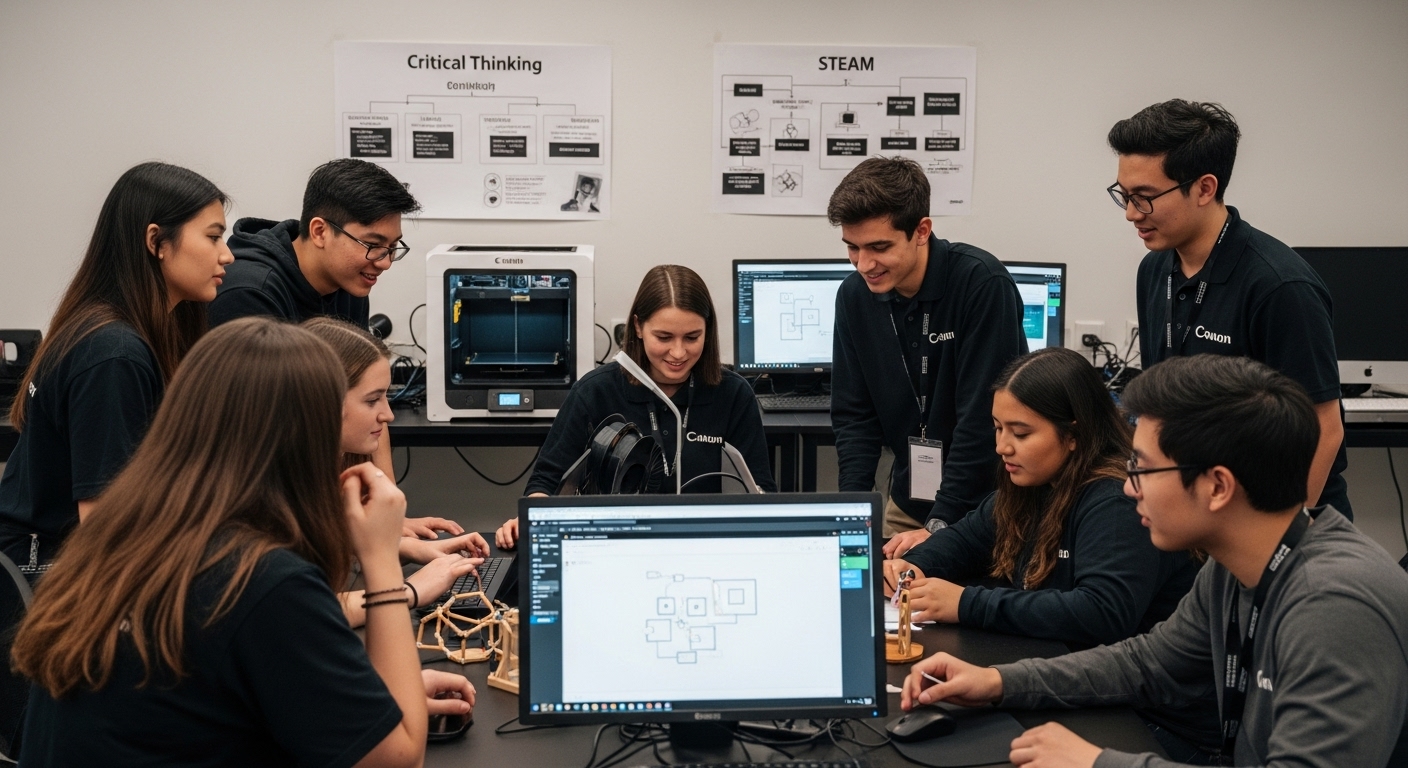
Critical thinking represents a complex cognitive skill that extends far beyond traditional memorization and rote learning. STEAM education provides a unique framework for developing sophisticated problem solving capabilities by creating an environment that challenges students to analyze, evaluate, and innovate across multiple disciplines.
Developing Analytical Problem Solving Skills
STEAM education transforms learning by presenting challenges that require multidimensional thinking. Read more about our innovative assembly programs that support this cognitive development. According to research from the Oregon Department of Education, this approach systematically builds students capacities to deconstruct complex problems through interdisciplinary strategies.
Key analytical skills developed through STEAM include:
- Breaking down complex problems into manageable components
- Identifying patterns and relationships across different domains
- Generating multiple potential solutions
- Evaluating proposed solutions critically
Encouraging Metacognitive Reflection
Metacognition represents a higher order thinking skill where students learn to understand and monitor their own thought processes. STEAM education creates structured opportunities for students to reflect on their learning strategies, analyze their problem solving approaches, and continuously refine their thinking methods.
By integrating disciplines that require different cognitive approaches students learn to:
- Question their initial assumptions
- Recognize potential biases in their thinking
- Adapt strategies based on feedback
- Understand the complexity of real world challenges
Fostering Creative and Adaptive Thinking
Critical thinking in STEAM goes beyond traditional logical reasoning. It encompasses creative problem solving that allows students to approach challenges with flexibility, imagination, and innovative strategies. This approach prepares learners to navigate unpredictable scenarios by developing cognitive adaptability that transcends traditional academic boundaries.
The integrated nature of STEAM education ensures that students do not just learn facts but develop comprehensive cognitive frameworks that enable them to think deeply, creatively, and systematically about complex real world problems.
Real-World Applications and Benefits of STEAM Education
STEAM education bridges academic learning with practical, transformative experiences that prepare students for complex professional environments. By integrating multiple disciplines, this approach equips learners with versatile skills that are increasingly valuable in rapidly evolving global contexts.
Innovative Career Preparation
Modern professional landscapes demand professionals who can navigate interdisciplinary challenges with creativity and technical proficiency. Explore our innovative assembly programs that support skill development. According to research from the International Society for Technology in Education, STEAM education provides students with essential skills for emerging careers that require sophisticated problem solving capabilities.
Key career readiness benefits include:
- Developing adaptable professional skills
- Understanding complex technological systems
- Creating innovative solutions to multifaceted problems
- Building collaborative workplace competencies
Addressing Global Challenges
STEAM education empowers students to become proactive problem solvers capable of addressing significant global challenges. By learning to integrate knowledge across disciplines, students develop comprehensive understanding of complex systemic issues such as climate change, healthcare innovations, and technological disruptions.
Global problem solving skills cultivated through STEAM include:
- Analyzing complex environmental challenges
- Designing sustainable technological solutions
- Understanding interconnected global systems
- Developing empathetic and strategic approaches to societal issues
Fostering Personal and Professional Growth
Beyond technical skills, STEAM education nurtures critical personal development attributes. Students learn to embrace uncertainty, experiment fearlessly, and view failures as opportunities for learning and innovation. This approach cultivates resilience, creativity, and a growth mindset that extends far beyond traditional academic boundaries.
The transformative power of STEAM lies in its ability to help students recognize their potential as creators, innovators, and change makers who can design meaningful solutions to real world challenges.
Bring Real-World STEAM Learning to Life at Your School
Is your school ready to overcome the challenges of disconnected subjects and traditional instruction? Many educators recognize the value of STEAM education but struggle to find engaging ways to reinforce critical thinking, creativity, and interdisciplinary problem solving in a way that truly excites students. Scheer Genius Assembly Shows offers a powerful solution that brings curriculum-aligned STEAM concepts to life through interactive, hands-on performances designed for elementary and middle schools.
Unleash your students’ curiosity and equip them to tackle tomorrow’s problems today. Visit AssemblyShows.com to discover high-energy STEAM assemblies led by a nationally recognized educational performer. Secure your school’s spot now for a unique learning transformation that goes beyond the classroom. Explore the latest assemblies or learn about all our educational entertainment options for your region at AssemblyShows.com.
Frequently Asked Questions
What is STEAM education?
STEAM education is an integrated educational framework that combines science, technology, engineering, arts, and mathematics, emphasizing interdisciplinary learning and holistic problem-solving.
Why is STEAM education important?
STEAM education is vital for preparing students for the modern workforce, equipping them with essential skills such as critical thinking, creativity, and collaboration, which are required to tackle complex challenges in various fields.
How does STEAM education benefit students?
Students benefit from STEAM education by developing adaptable cognitive skills, enhancing creativity, fostering innovation, and building technological literacy through interconnected learning experiences.
What are the key components of STEAM education?
The key components of STEAM education include science, technology, engineering, arts, and mathematics, all of which work together to provide a comprehensive learning experience that prepares students for real-world problem-solving.