
Imagine a classroom where excitement fills the air and hands-on experiments turn ordinary students into eager scientists. Studies show that science assemblies can boost student understanding of key concepts by up to 27%. Schools across the country now use these lively gatherings to make science fun and memorable, offering experiences that make complex ideas clear and spark lasting curiosity.
Key Takeaways
| Point | Details |
|---|---|
| Interactive Learning | Science assemblies provide hands-on, engaging experiences that enhance student understanding of complex scientific topics. |
| Curriculum Alignment | Programs are designed to align with educational standards, ensuring they complement classroom learning effectively. |
| Diverse Formats | Assemblies vary in format, including interactive demonstrations and workshops, catering to different age groups and learning environments. |
| Safety and Planning | Careful planning and safety considerations are crucial for successful assembly execution, including aligning with curriculum and verifying presenter credentials. |
Table of Contents
- Defining Science Assembly For Schools
- Types Of Science Assemblies And Formats
- Core Educational Goals And Benefits
- Planning, Booking, And Safety Considerations
- Best Practices For Memorable Science Assemblies
Defining Science Assembly for Schools
A science assembly represents a powerful educational platform where students gather to explore scientific concepts through engaging, interactive presentations. Learn more about our unique approach to school assemblies. These specialized programs transform traditional learning by bringing curriculum-aligned scientific content directly to students in a dynamic, memorable format.
According to research from Wikipedia, a school assembly serves as a gathering where students collectively experience special educational programs or presentations. In the context of science education, these assemblies become transformative experiences that extend learning beyond textbooks. Schools leverage these opportunities to introduce complex scientific topics through expert-led demonstrations, interactive experiments, and immersive storytelling that capture students’ imagination.
The impact of science assemblies goes far beyond simple information delivery. Research from the nonprofit Action for the Climate Emergency demonstrates that targeted educational assemblies can lead to significant knowledge gains. Their studies revealed that well-designed science presentations can increase student understanding by up to 27%, creating measurable improvements in scientific literacy and engagement.
Key benefits of science assemblies include:
- Interactive learning experiences
- Direct exposure to scientific demonstrations
- Enhanced student engagement with complex topics
- Curriculum-aligned educational content
- Inspiration for future scientific exploration
Types of Science Assemblies and Formats
Science assemblies come in diverse formats designed to captivate and educate students across different age groups and learning environments. Explore our comprehensive STEM assembly programs that transform scientific learning into exciting, interactive experiences. According to research from Mobile Ed Productions, these programs range from targeted 45-minute shows to comprehensive all-day hands-on events that cater to varied educational needs.
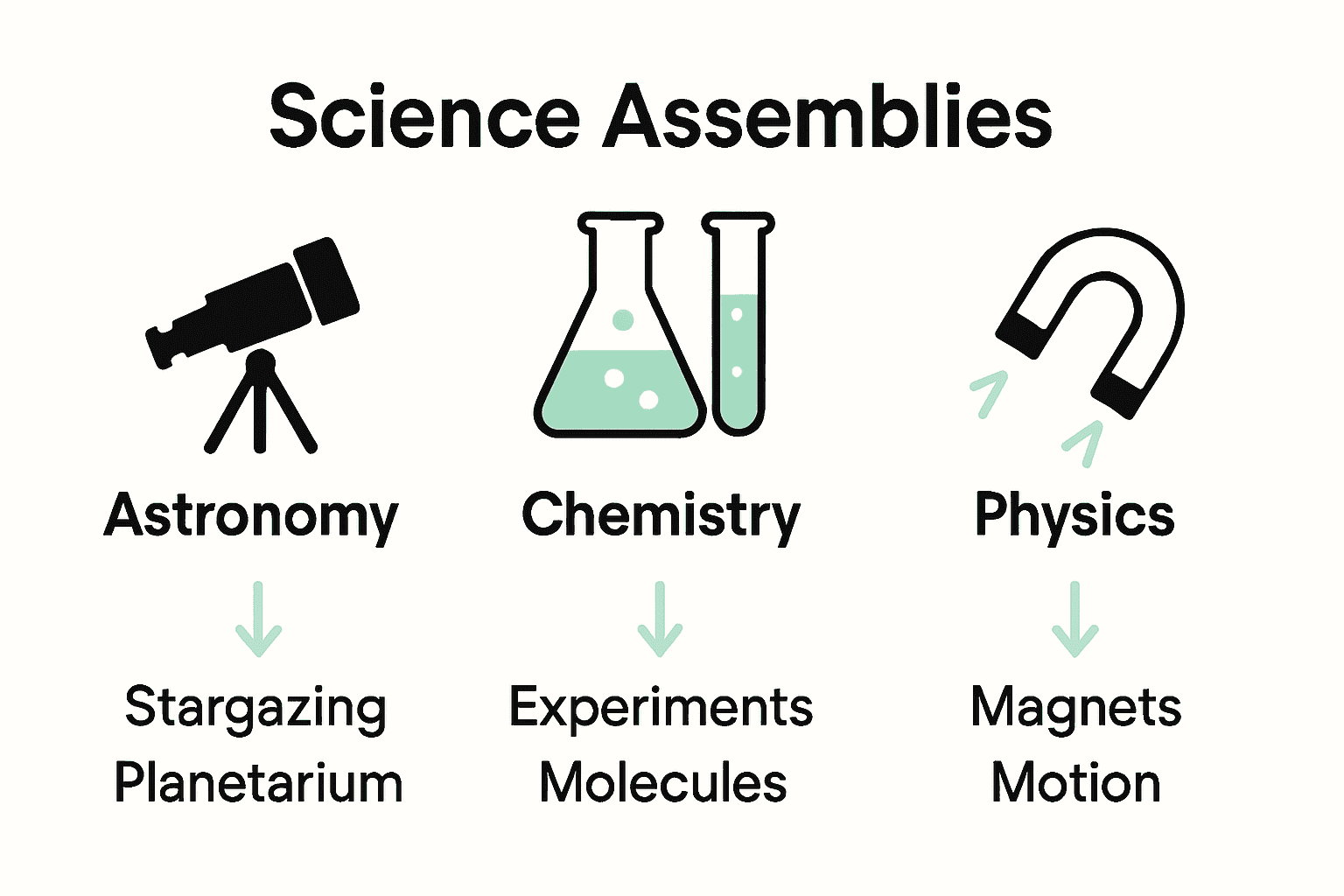
The primary types of science assemblies typically encompass specialized themes that align with core scientific disciplines. These include:
Here’s a comparison of key types of science assemblies and their typical features:
| Assembly Type | Main Focus | Common Format | Example Activities |
|---|---|---|---|
| Astronomy | Space & planets | Portable planetarium | Sky tours Star mapping |
| Chemistry | Chemical reactions | Interactive demo show | Hands-on experiments Visual effects |
| Earth Science | Geology & Earth | Presentation or exhibit | Rock/fossil displays Model volcanoes |
| Physics | Scientific principles | Live demonstration | Force demonstrations Energy activities |
| STEM/STEAM | Integrated sciences | Workshop or show | Robotics Engineering challenges |
- Astronomy assemblies featuring portable planetariums
- Chemistry demonstrations with interactive experiments
- Earth Science presentations exploring geological concepts
- Physics shows demonstrating fundamental scientific principles
- STEM/STEAM programs integrating multiple scientific disciplines
According to research from Schools Science Assemblies, these programs are flexible and adaptable, offering both in-person and virtual presentation formats. This versatility ensures that schools can access high-quality scientific education regardless of physical constraints. Modern science assemblies are meticulously designed to align with curriculum requirements, providing educators with powerful supplementary learning tools that make complex scientific concepts accessible and engaging for students.
The hallmark of effective science assemblies is their ability to transform abstract scientific principles into tangible, memorable experiences. By combining expert presentations, interactive demonstrations, and age-appropriate content, these programs inspire curiosity and spark potential future interest in scientific exploration among students.
Core Educational Goals and Benefits
Science assemblies are strategic educational tools designed to extend learning beyond traditional classroom boundaries. Learn more about curriculum enrichment strategies that transform educational experiences. According to research from One Belief Organization, these programs bring fresh perspectives and support comprehensive student development through shared, inspirational experiences that go well beyond standard academic instruction.
The core educational goals of science assemblies are multifaceted and profound. These programs aim to:
- Supplement traditional classroom learning
- Support character development
- Build community engagement
- Inspire curiosity and scientific exploration
- Provide immersive, interactive learning experiences
Research from the Action for the Climate Emergency nonprofit highlights the tangible impact of specialized assemblies. Their evaluation demonstrated significant educational benefits, including measurable increases in scientific knowledge and enhanced student engagement.
Specifically, students who participated in targeted science assemblies showed greater willingness to discuss complex scientific topics with peers and parents, indicating deeper learning and increased intellectual curiosity.
Ultimately, science assemblies serve as powerful catalysts for educational transformation. By presenting scientific concepts through dynamic, interactive presentations, these programs break down complex ideas into accessible, memorable experiences. They motivate students by making learning exciting, interactive, and personally relevant, thereby nurturing a generation of curious, scientifically literate individuals who are eager to explore and understand the world around them.
Planning, Booking, and Safety Considerations
Science assembly planning requires strategic coordination and thoughtful preparation to ensure maximum educational impact. Learn more about ensuring student safety during school events and create seamless, engaging experiences. According to research from Schools Science Assemblies, hosting successful educational assemblies demands careful engagement with experts, staff, and community organizations to deliver meaningful learning opportunities.
The booking process involves several critical considerations:
- Selecting age-appropriate themed programs
- Determining optimal performance length (45-minute vs. full-day)
- Securing appropriate performance spaces
- Coordinating technical equipment requirements
- Aligning programs with current curriculum standards
According to Mobile Ed Productions, schools must carefully evaluate multiple factors when booking science assemblies. This includes matching program content to specific grade levels, understanding curriculum alignment, and ensuring the presentation format meets the school’s educational objectives. Successful assembly planning requires collaboration among teachers, administrators, and presenters to create a cohesive and impactful learning experience.
Safety remains a paramount consideration throughout the planning process. School administrators must verify presenter credentials, review demonstration protocols, and ensure all activities meet district safety guidelines. By prioritizing student safety and educational quality, science assemblies can transform traditional learning environments into dynamic, interactive spaces that inspire scientific curiosity and deep, meaningful engagement with complex scientific concepts.

Best Practices for Memorable Science Assemblies
Science assemblies thrive on creating immersive, engaging experiences that transform learning from passive observation to active participation. Discover inspiring school assembly strategies that captivate students and spark scientific curiosity. According to research from the Science of Sound, truly memorable assemblies capture student attention through multi-sensory demonstrations that forge powerful connections between curriculum content and real-world scientific exploration.
Key best practices for creating exceptional science assemblies include:
- Immediate engagement through dynamic, interactive presentations
- Multi-sensory demonstrations that appeal to different learning styles
- Curriculum-aligned content with real-life scientific applications
- Hands-on or visual elements that make abstract concepts tangible
- Creating inclusive environments that encourage diverse student participation
Research from School Science Assemblies emphasizes the importance of interactive experiences that inspire further scientific exploration. Effective assemblies go beyond simple information delivery, motivating students to pursue additional learning through science clubs, library resources, or independent research. By presenting scientific concepts in an exciting, accessible manner, these programs can catalyze lasting cultural shifts, building student confidence and nurturing a genuine passion for scientific discovery.
The ultimate goal of a memorable science assembly is to transform scientific learning from a distant, theoretical concept into an exciting, personally relevant journey of discovery. By combining expert storytelling, interactive demonstrations, and curriculum-aligned content, these assemblies create magical moments that can inspire the next generation of scientists, innovators, and critical thinkers.
Bring Science Assemblies to Life With Unforgettable Experiences
Are you searching for an engaging way to boost STEM engagement and make curriculum content stick? The article highlights common challenges schools face, like getting students truly excited about science and translating abstract classroom learning into interactive, memorable experiences. With hands-on demonstrations and live educational entertainment, your next assembly can be the talk of the school.
Explore our dynamic Assemblies programs that make science sparkle for students of all ages.
Let your students experience the excitement of science firsthand. Discover why schools across the Midwest trust AssemblyShows.com for high-energy, curriculum-aligned assemblies both in-person and online. Spots fill quickly, so choose your next science assembly now and inspire a love of learning that lasts long after the bell rings. Book today to transform your next school event into an unforgettable educational journey.
Frequently Asked Questions
What is a science assembly?
A science assembly is an educational program where students gather to engage with scientific concepts through interactive presentations and demonstrations.
What are the benefits of having a science assembly in schools?
Science assemblies provide interactive learning experiences, enhance engagement with complex scientific topics, support curriculum alignment, and inspire students’ interest in science.
What types of science assemblies are available for different age groups?
Types of science assemblies include Astronomy, Chemistry, Earth Science, Physics, and STEM/STEAM programs, each designed to captivate students through thematic content and interactive demonstrations.
How can schools ensure safety when planning a science assembly?
Schools can ensure safety by verifying presenter credentials, reviewing demonstration protocols, and ensuring all activities align with district safety guidelines.
Recommended
- Understanding Stem Assembly Programs Explained – Scheer Genius Assembly Shows
- Understanding Why Host Educational Assemblies in Schools – Scheer Genius Assembly Shows
- 8 Creative Middle School Assembly Ideas to Engage Students – Scheer Genius Assembly Shows
- Benefits of Assembly Shows Are Often Overlooked