
Hands-on learning flips the classroom upside down. Students do not just listen to a teacher talk at the front of the room. They grab, build, experiment and figure things out for themselves. Academic studies found that students who learn by doing are up to 50 percent more likely to remember lessons over time. Most people think learning is all about memorizing facts with a pencil and paper. Turns out, getting your hands dirty is what makes real knowledge stick and opens doors to deeper problem solving.
Table of Contents
- Defining Hands-On Learning And Its Core Principles
- The Importance Of Hands-On Learning In Education
- How Hands-On Learning Encourages Active Participation
- Exploring Practical Applications Of Hands-On Learning
- Real-World Examples Of Successful Hands-On Learning
Quick Summary
| Takeaway | Explanation |
|---|---|
| Hands-on learning enhances understanding and retention | Direct interaction with materials boosts comprehension, resulting in better retention of knowledge over time. |
| Active participation fosters engagement and motivation | Students become active contributors, increasing intrinsic motivation and reducing anxiety associated with learning. |
| Interdisciplinary applications support real-world skills | Engaging in hands-on learning across subjects helps students apply knowledge practically, preparing them for real challenges. |
| Technology enhances hands-on learning experiences | Integrating technology into experiential learning creates dynamic environments, allowing students to engage actively with content. |
| Real-world projects build critical skills | Project-based learning connects theoretical concepts to practical applications, enhancing essential skills like teamwork and problem-solving. |
Defining Hands-On Learning and Its Core Principles
Hands-on learning represents a dynamic educational approach where students directly engage with materials, tools, and experiences to build understanding. Unlike traditional lecture-based methods, this approach transforms learning from passive absorption to active exploration and discovery.
The following table summarizes the key characteristics that differentiate hands-on learning from traditional lecture-based learning, helping clarify the unique advantages of each approach.
| Approach | Student Role | Teaching Method | Engagement Level | Typical Activities |
|---|---|---|---|---|
| Hands-On Learning | Active participant | Experiential, interactive | High | Experiments, building, problem solving |
| Traditional Lecture-Based | Passive observer | Teacher-centered lecture | Low | Note-taking, listening, memorization |
The Essence of Learning by Doing
At its core, hands-on learning is about direct interaction with educational content. Students move beyond reading or listening to actually manipulating objects, conducting experiments, solving real-world problems, and creating tangible outcomes.
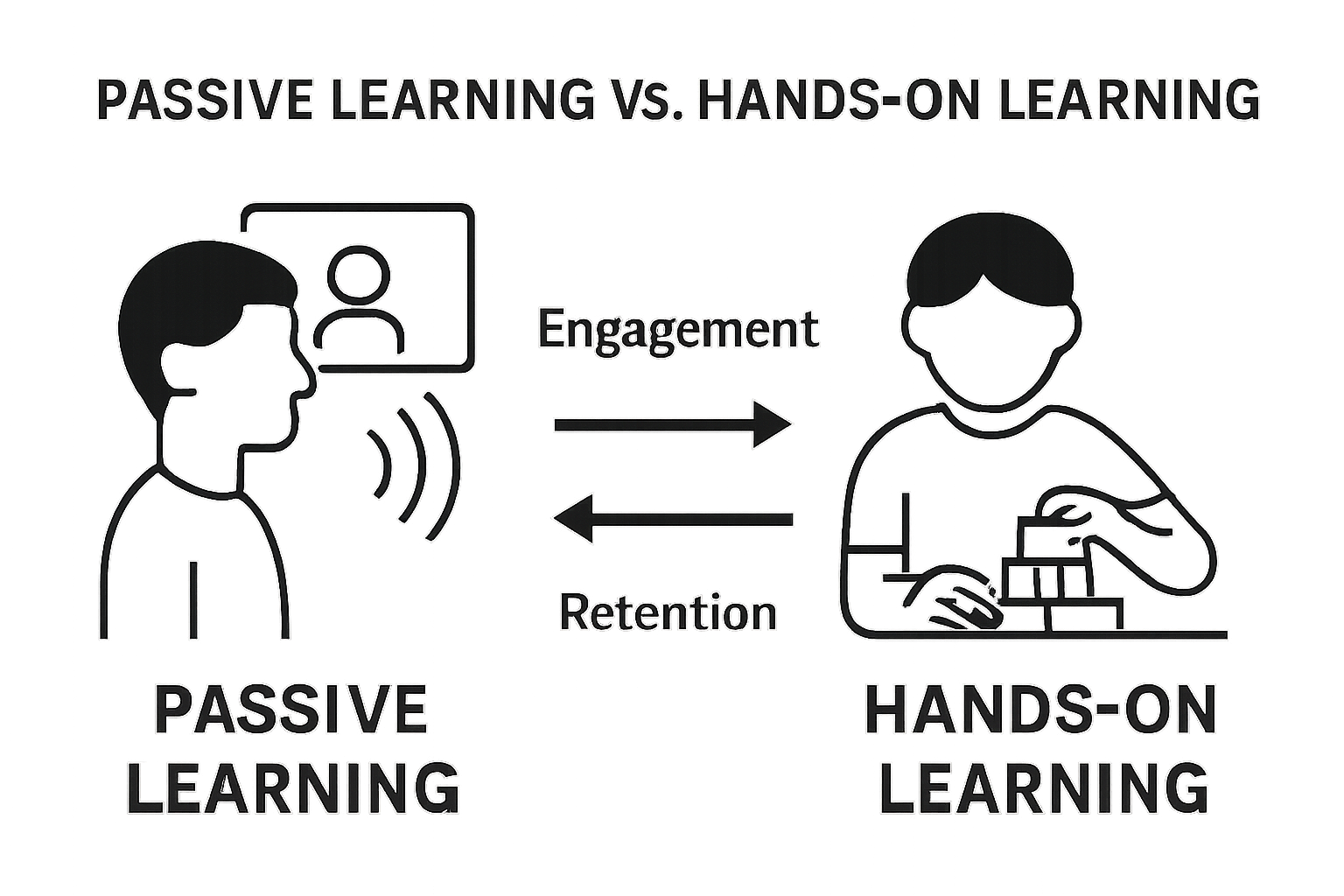 Research from educational psychology confirms that this method significantly enhances comprehension and retention.
Key characteristics of hands-on learning include:
- Active student participation
- Immediate application of theoretical knowledge
- Development of practical skills
- Enhanced critical thinking capabilities
- Increased engagement and motivation
Theoretical Foundations and Practical Applications
The concept of hands-on learning draws from constructivist learning theories, which suggest that individuals construct knowledge through experiences and reflection. Brookings Institution research highlights that this approach goes beyond physical manipulation, emphasizing minds-on engagement where students critically analyze and interpret their direct experiences.
Practical applications span multiple educational domains. In science classrooms, students might conduct chemistry experiments. In mathematics, they could use manipulatives to understand geometric concepts. Engineering programs often use project-based learning where students design and build functional prototypes.
By prioritizing experiential learning, educators create environments where students become active knowledge creators rather than passive information receivers. This approach prepares learners with adaptable skills crucial for real-world problem solving and professional success.
The Importance of Hands-On Learning in Education
Hands-on learning transcends traditional educational paradigms by creating immersive, interactive experiences that dramatically transform student engagement and knowledge acquisition. This approach is not merely an instructional technique but a fundamental strategy for preparing students to navigate complex real-world challenges.
Cognitive and Developmental Benefits
Engaging directly with learning materials triggers multiple cognitive processes that significantly enhance understanding. Neurological research demonstrates that physical interaction with learning content stimulates different brain regions compared to passive listening, creating more robust neural connections.
Key cognitive advantages include:
This table highlights the cognitive and developmental benefits of hands-on learning, making it easier to see which areas of student growth are supported by this approach.
| Cognitive/Developmental Benefit | How Hands-On Learning Supports It |
|---|---|
| Memory retention | Encourages interaction with material, reinforcing memory |
| Problem-solving skills | Engages students in practical tasks and real challenges |
| Abstract thinking | Facilitates understanding of concepts through experience |
| Neural pathway development | Stimulates different brain regions via direct engagement |
| Conceptual understanding | Deepens understanding by connecting theory to practice |
- Enhanced memory retention
- Improved problem solving skills
- Greater capacity for abstract thinking
- Increased neural pathway development
- Deeper conceptual understanding
Bridging Academic Theory and Practical Application
Research from the National Museum of Science reveals that hands-on learning dramatically narrows achievement gaps, particularly in underserved educational environments. By transforming abstract concepts into tangible experiences, students can connect theoretical knowledge with practical implementation.
In subjects like science, technology, engineering, and mathematics (STEM), hands-on learning becomes particularly critical. Students move beyond memorization to actual experimentation, design, and problem solving. A physics student might construct simple machines, while a biology student could conduct field research, turning classrooms into dynamic laboratories of discovery.
Moreover, this approach cultivates essential 21st-century skills such as critical thinking, creativity, collaboration, and adaptability. By experiencing learning as an active, immersive process, students develop the intellectual flexibility required in rapidly evolving professional landscapes.
How Hands-On Learning Encourages Active Participation
Hands-on learning transforms students from passive observers to engaged participants, creating dynamic educational environments where interaction and personal discovery become the primary learning mechanisms. This approach fundamentally reimagines how students connect with academic content.
Breaking Down Passive Learning Barriers
Research from Carnegie Mellon University demonstrates that interactive learning methods significantly outperform traditional lecture formats by compelling students to become active contributors to their educational experience. Active participation means students are not just receiving information but constructing understanding through direct engagement.
Key elements that drive active participation include:
- Personal agency in learning process
- Immediate feedback mechanisms
- Collaborative problem solving
- Intrinsic motivation development
- Reduced learning anxiety
Interactive Learning Strategies
Interactive learning strategies encompass multiple approaches that encourage student involvement. Group projects, laboratory experiments, simulation exercises, and real-world problem solving transform classrooms into collaborative learning spaces. These methods require students to think critically, communicate effectively, and apply theoretical knowledge in practical contexts.
In mathematics, for instance, students might use physical manipulatives to understand geometric concepts. Science classes could involve conducting experiments, while social studies might include role playing historical scenarios. Explore how diversity and inclusion assemblies can further enhance interactive learning experiences.
By positioning students as active knowledge creators rather than passive recipients, hands-on learning cultivates deeper intellectual engagement. This approach not only improves academic performance but also builds essential life skills such as critical thinking, creativity, and collaborative problem solving.
Exploring Practical Applications of Hands-On Learning
Hands-on learning extends far beyond theoretical concepts, offering tangible strategies that transform educational experiences across multiple disciplines. By bridging academic knowledge with real-world skill development, this approach prepares students for complex professional environments and lifelong learning challenges.
Interdisciplinary Learning Environments
Practical applications of hands-on learning manifest through diverse educational settings that prioritize interactive, experiential methodologies. Immersive learning experiences enable students to translate abstract concepts into concrete understanding across various academic domains.
Key interdisciplinary applications include:
- Science laboratories with experimental design
- Engineering workshops with prototype development
- Computer science courses with coding projects
- Art studios featuring collaborative creation
- Mathematics classes using spatial reasoning tools
Technology and Experiential Learning
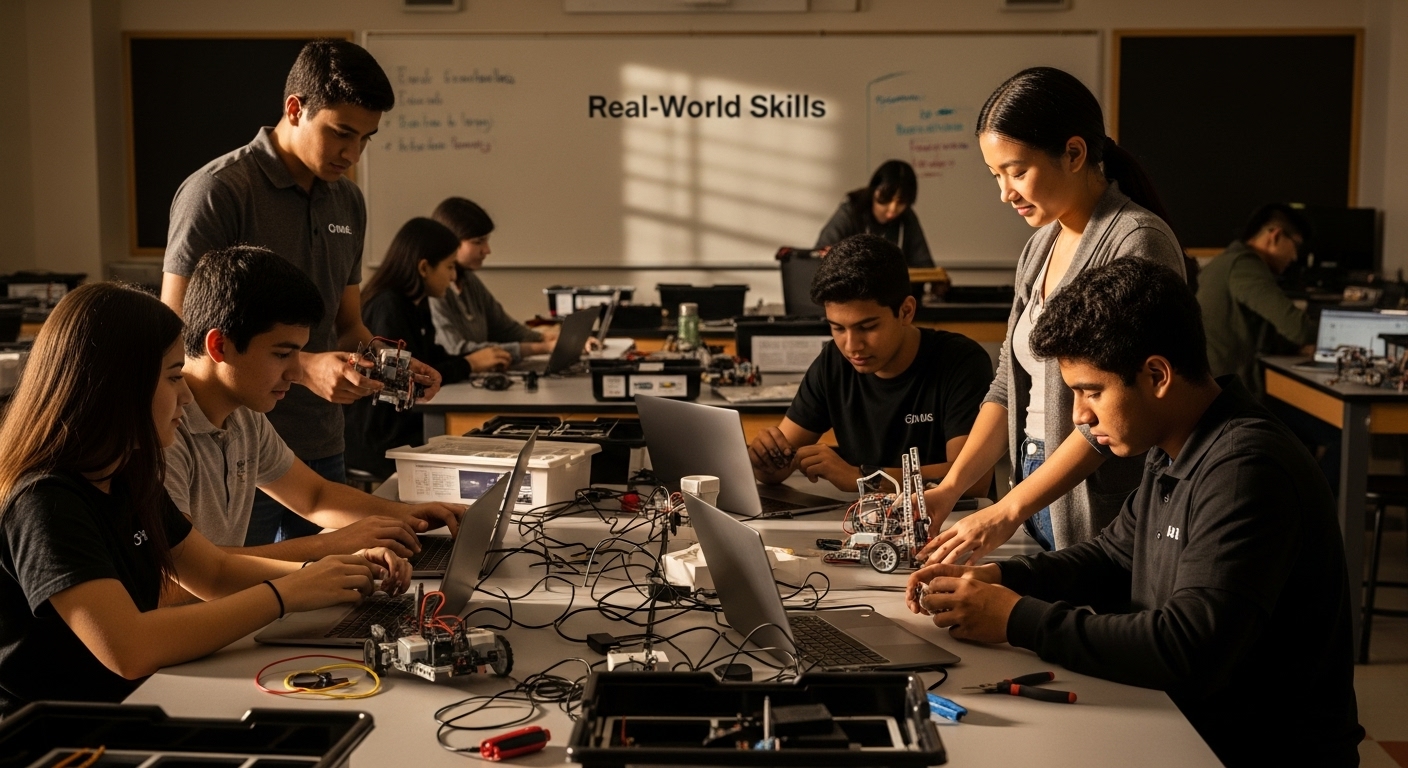
Research from a Midwestern university demonstrates that project-based learning significantly enhances student motivation and skill acquisition. In computer science programs, students might develop software applications, design algorithms, or create technological solutions that solve real-world problems.
Technology-enhanced hands-on learning creates dynamic educational environments where students become active creators rather than passive consumers of information. Virtual reality simulations, robotics workshops, and interactive digital platforms provide immersive experiences that transcend traditional classroom boundaries.
Moreover, these practical applications cultivate transferable skills such as critical thinking, problem solving, collaboration, and adaptability. By engaging directly with complex challenges, students develop the intellectual resilience necessary for success in rapidly evolving professional landscapes.
Real-World Examples of Successful Hands-On Learning
Hands-on learning transcends theoretical discussions by demonstrating tangible, impactful educational strategies that transform student experiences across diverse disciplines. By showcasing concrete examples, we illuminate how interactive learning methodologies create profound educational opportunities.
STEM and Innovation Pathways
Research from the University of Pennsylvania reveals groundbreaking approaches to hands-on education. The inventXYZ program exemplifies innovative learning by challenging high school students to develop complex technological projects such as:
- Coding handheld video games
- Creating COVID-19 spread simulators
- Applying advanced algebraic concepts through practical design
- Developing interactive technological solutions
- Integrating computational thinking with real-world problem solving
Interdisciplinary Project-Based Learning
Successful hands-on learning models demonstrate how students can bridge academic knowledge with practical application. Stanford Graduate School of Education highlights extraordinary examples where students collaborate with professional institutions, such as students designing a solar-powered boat in partnership with the Jet Propulsion Laboratory and Cal Tech.
These experiences go beyond traditional classroom learning by providing authentic challenges that require critical thinking, teamwork, and creative problem solving. Check out our guide on engaging elementary school assembly ideas to see how interactive learning can be implemented across different educational contexts.
By creating environments where students become active creators rather than passive recipients, hands-on learning cultivates essential skills that prepare learners for complex, dynamic professional landscapes. The most successful models seamlessly integrate theoretical knowledge with practical, meaningful experiences.
Bring Hands-On Learning to Life With Unforgettable School Assemblies
Does your school struggle to spark real engagement and make academic concepts truly stick? As explored in ‘What is Hands-On Learning? Understanding Its Impact,’ passive education frequently leaves students disconnected and unmotivated. When students only listen rather than participate, they miss out on deeper understanding, skill-building, and genuine excitement for learning.
Imagine your students experiencing science, teamwork, or critical thinking through interactive live shows where they are at the heart of discovery. At AssemblyShows.com, we turn hands-on learning into memorable events that energize classrooms and bring curriculum to life. Transform your next school assembly into a powerful educational journey—visit our engaging assembly ideas or learn more about how we emphasize active participation in our diversity and inclusion assemblies. Book your school’s interactive experience today, and help your students build skills that last a lifetime.
Frequently Asked Questions
What is hands-on learning?
Hands-on learning is an educational approach where students actively engage with materials and experiences to enhance their understanding, moving beyond traditional lecture-based methods.
What are the benefits of hands-on learning in education?
Hands-on learning promotes cognitive development by improving memory retention, problem-solving skills, and abstract thinking while also bridging the gap between academic theory and practical applications.
How does hands-on learning enhance student engagement?
By transforming students from passive observers to active participants, hands-on learning fosters immediate application of knowledge, personal agency, and collaborative problem-solving, which increases motivation and reduces learning anxiety.
Can hands-on learning be applied across different subjects?
Yes, hands-on learning can be integrated into various disciplines, including science, technology, engineering, mathematics (STEM), art, and social studies, by utilizing interactive strategies that connect theoretical concepts with real-world applications.
Recommended
- Understanding Diversity and Inclusion Assemblies in Schools – Scheer Genius Assembly Shows
- Advice for School show performers: How to make special needs kids feel included. – Doug Scheer assembly shows
- Are School Assembly Shows Truly Beneficial? | Doug Scheer
- 8 Fun Elementary School Assembly Ideas for Engaging Students – Scheer Genius Assembly Shows