
Classroom assemblies are supposed to spark excitement and learning for students. Yet most teachers and administrators know the reality feels very different. Even though the most effective assemblies stick to a focused 30-45 minute window, keeping students engaged from start to finish, many gatherings quickly lose direction or become chaotic. That is not because assemblies do not matter, but because a few simple preparation steps can flip even the most routine event into a powerful memory for your school.
Table of Contents
- Step 1: Define The Purpose And Agenda Of The Assembly
- Step 2: Assemble Necessary Materials And Resources
- Step 3: Schedule And Reserve The Assembly Location
- Step 4: Communicate Details To Participants And Staff
- Step 5: Execute The Assembly With Clarity And Structure
- Step 6: Gather Feedback And Review For Future Improvements
Quick Summary
| Key Point | Explanation |
|---|---|
| 1. Define assembly purpose clearly | A well-defined objective enhances engagement and learning outcomes for students during the assembly. |
| 2. Prepare necessary materials in advance | Gathering all required resources ensures a smooth presentation and reduces last-minute issues during the assembly. |
| 3. Choose the right venue strategically | The assembly location affects student engagement and should match the event’s goals and expected attendance. |
| 4. Communicate assembly details effectively | Clear communication to all participants builds anticipation and prevents misunderstandings about the assembly’s purpose and logistics. |
| 5. Gather feedback for future improvements | Collecting and reviewing feedback helps refine future assemblies, enhancing educational experiences for both students and educators. |
Step 1: Define the Purpose and Agenda of the Assembly
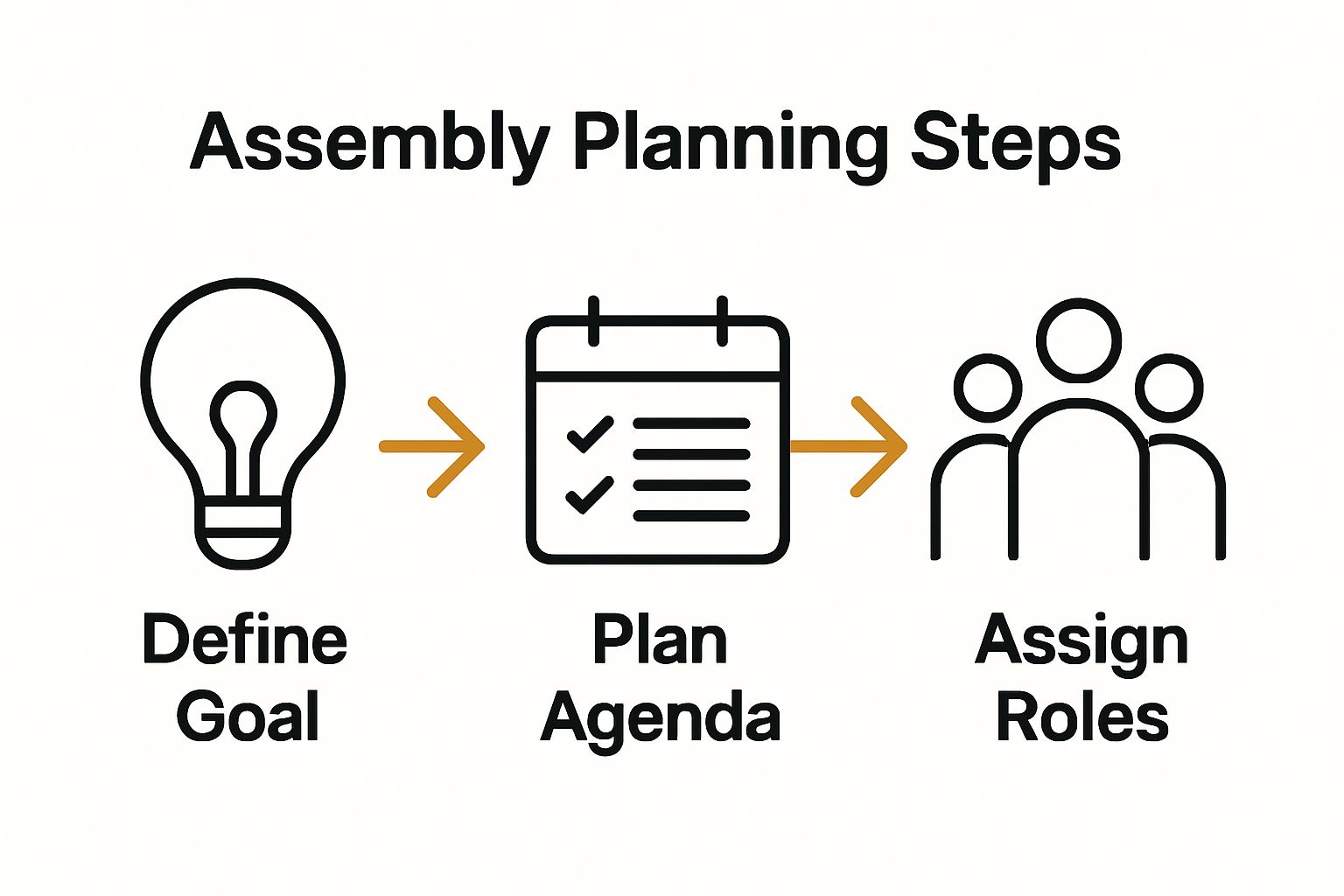
Successful classroom assembly preparation begins with crystal clear purpose and strategic agenda planning. Administrators and teachers must approach this initial stage with intentional focus, understanding that a well-defined assembly objective drives engagement and learning outcomes.
Defining the assembly’s purpose requires thoughtful consideration of multiple educational and developmental goals. School leaders should start by asking fundamental questions about the intended impact. Are you aiming to inspire students about a specific topic? Commemorate a historical event? Introduce a critical social concept? Introduce a community expert or performer? Each purpose demands a unique approach and careful preparation.
The agenda development process involves mapping out precise timing, participant roles, and desired takeaways. Create a comprehensive framework that allocates specific segments for introduction, core content, interactive elements, and conclusion. Precise time management prevents assemblies from becoming unfocused or losing student attention. Most successful classroom assemblies maintain a tight 30-45 minute window, balancing information delivery with dynamic engagement strategies.
Consider consulting colleagues and administrative teams during this planning stage. Collaborative input helps refine the assembly’s focus and ensures alignment with broader educational objectives. Learn more about creating impactful educational assemblies to gain additional insights into effective planning.
Verification of a well-defined assembly involves answering these key questions:
- Does the assembly have a clear, measurable objective?
- Will students understand the core message within the allocated time?
- Have you incorporated interactive or participatory elements?
- Does the agenda support curriculum-related learning goals?
By meticulously defining purpose and crafting a strategic agenda, educational leaders transform assemblies from routine events into powerful learning experiences that captivate and educate students.
Step 2: Assemble Necessary Materials and Resources
With the assembly purpose and agenda defined, the next critical step in classroom assembly preparation involves strategically gathering all necessary materials and resources. Comprehensive preparation prevents last-minute scrambling and ensures a smooth, professional presentation.
The resource collection process begins with a detailed review of your assembled agenda. Each segment requires specific materials that support the assembly’s educational objectives. Technology plays a significant role in modern classroom assemblies, so confirming audiovisual equipment becomes paramount. This includes checking projectors, microphones, speakers, and ensuring compatible connection cables. Schools often encounter technical challenges, so having backup equipment or alternative presentation methods represents smart contingency planning.
Print materials represent another crucial resource category. Depending on the assembly’s purpose, you might need handouts, worksheets, visual aids, or reference documents. Prepare these materials in advance and create sufficient copies for all participants. Consider creating digital versions as well, which can be easily shared with students and staff through school communication platforms.
Understand more about creating engaging educational assemblies to enhance your resource preparation strategy.
Resource verification involves a comprehensive checklist:
- Are all technological devices functioning correctly?
- Have you prepared sufficient printed materials?
- Do you have backup equipment or alternative presentation methods?
- Are materials aligned with the assembly’s specific objectives?
- Have you tested all audiovisual equipment in the presentation space?
By methodically assembling and verifying resources, educators transform potential logistical challenges into seamless learning experiences.
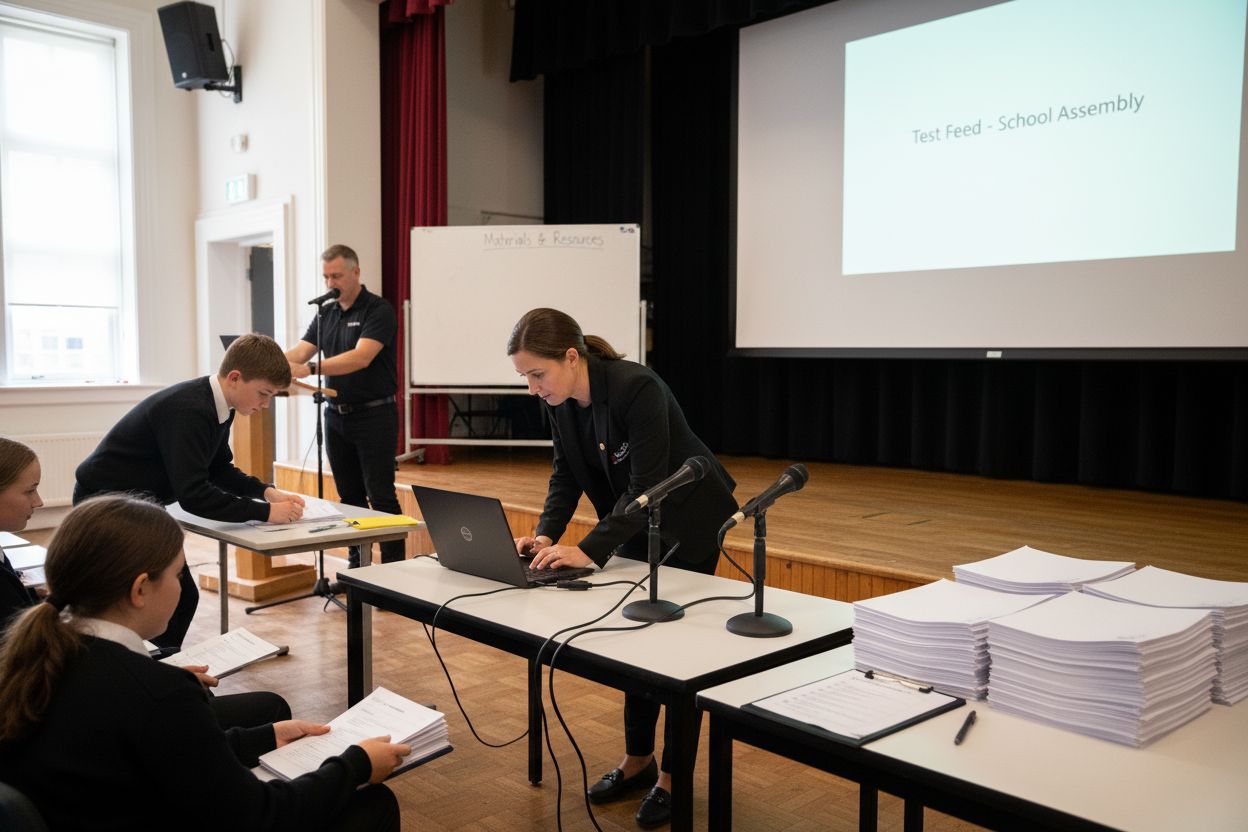 Thorough preparation demonstrates professionalism and ensures that the assembly can proceed without unexpected interruptions, maintaining student engagement and supporting the intended educational goals.
Below is a checklist table to verify that all critical resources and materials have been prepared for the classroom assembly.
| Resource/Material | Verification Step | Purpose |
|---|---|---|
| Audiovisual Equipment | Test all devices for proper function | Supports multimedia presentations |
| Printed Materials | Prepare enough copies for all participants | Enhances understanding and participation |
| Backup Equipment | Ensure alternative methods are available | Prevents disruptions from technical issues |
| Digital Materials | Create and share digital versions if applicable | Easy access and wide distribution |
| Aligned Content | Check materials align with assembly objectives | Maintains relevance to educational goals |
| Presentation Space Tech | Test all AV in actual location | Ensures readiness in live assembly setting |
Step 3: Schedule and Reserve the Assembly Location
Scheduling and reserving the appropriate assembly location represents a pivotal step in classroom assembly preparation. Selecting the right venue directly impacts student engagement, logistical effectiveness, and overall assembly success. School administrators must approach this process with strategic planning and proactive communication.
The location selection process begins by matching the assembly’s purpose with the most suitable physical space. Large school auditoriums work well for full student body events, while smaller multipurpose rooms might better accommodate more intimate presentations. Consider factors such as room capacity, acoustics, visibility, and available technological infrastructure. Some assemblies might require specialized configurations like stage access, projection capabilities, or specific seating arrangements.
Coordinating with school administrative staff becomes crucial during this reservation phase. Communicate the assembly’s specific requirements, anticipated attendance, and technical needs well in advance. Learn more about scheduling assembly logistics to streamline your planning process. Many schools utilize centralized scheduling systems or shared calendars to prevent venue conflicts and ensure smooth operational coordination.
Venue verification involves a comprehensive assessment:
- Is the selected location appropriate for the assembly’s objectives?
- Does the space accommodate expected participant numbers?
- Are necessary technological resources available and functional?
- Have you confirmed the location with school administration?
- Are there potential scheduling conflicts with other school activities?
By meticulously planning and reserving the assembly location, educators create a foundation for a successful, engaging educational experience that maximizes student learning potential.
Step 4: Communicate Details to Participants and Staff
Communicating assembly details effectively represents a critical step in ensuring smooth execution and maximum participation. Clear, comprehensive communication prevents misunderstandings and builds anticipation among students, teachers, and administrative staff. The communication strategy must be deliberate, multi-channel, and tailored to different audience needs.
Initiate communication by developing a detailed information packet that outlines the assembly’s purpose, logistical specifics, and expected participant roles. This packet should include precise timing, location details, dress code requirements (if applicable), and any preparatory actions participants need to take. Email remains the primary professional communication method, but supplement digital communications with printed notices distributed through classroom channels. Consider creating visual aids like infographics or brief announcement slides that can be shared across school communication platforms.
Different stakeholder groups require nuanced communication approaches. Teachers need comprehensive background information to prepare their students, while students benefit from engaging, concise messaging that sparks curiosity and explains the assembly’s relevance. Explore strategies for effective educational assembly communication to refine your approach.
Communication verification involves assessing these key elements:
- Have all relevant staff received detailed assembly information?
- Are students informed about the assembly’s purpose and expectations?
- Have you used multiple communication channels?
- Is the messaging clear, concise, and age-appropriate?
- Have you provided mechanisms for questions or follow-up communication?
By establishing robust, transparent communication protocols, educational leaders transform assembly preparation from a logistical challenge into an opportunity for building school community engagement and excitement around learning experiences.
Step 5: Execute the Assembly with Clarity and Structure
Executing the assembly demands precision, adaptability, and a structured approach that maintains student engagement while delivering the intended educational message. Successful assembly delivery transforms careful preparation into a dynamic learning experience that captivates and inspires students.
Begin by arriving at the venue significantly early to conduct final technical and logistical checks. Ensure all audiovisual equipment functions correctly, seating arrangements meet the planned configuration, and any interactive materials are strategically positioned. The first few minutes of the assembly set the tone, so develop a strong opening that immediately captures student attention. This might involve an intriguing question, a brief interactive demonstration, or a compelling narrative that connects directly to the assembly’s core objectives.
Maintaining a fluid pace becomes crucial during the presentation. Transition smoothly between different segments, using clear verbal cues and deliberate movement to signal shifts in content or activity. Incorporate interactive elements that encourage student participation, such as brief Q&A segments, quick group activities, or moments of guided reflection. Discover strategies for creating engaging educational presentations to enhance your delivery approach.
Assembly execution verification involves assessing these critical elements:
- Did the assembly maintain student engagement throughout?
- Were all planned objectives successfully communicated?
- Did technical elements and transitions proceed smoothly?
- Were interactive components effectively integrated?
- Did the presentation stay within the predetermined time frame?
By executing the assembly with intentional structure and dynamic engagement, educators transform a potentially mundane event into a memorable learning opportunity that resonates with students long after the presentation concludes.
Step 6: Gather Feedback and Review for Future Improvements
The final step in classroom assembly preparation involves a critical reflection process that transforms individual experiences into systemic educational improvement. Comprehensive feedback collection and thoughtful review serve as the cornerstone of evolving assembly strategies and enhancing future educational experiences.
Initiate the feedback process immediately following the assembly by designing targeted assessment tools. Create concise surveys for students, teachers, and administrative staff that capture both quantitative ratings and qualitative insights. Digital survey platforms offer efficient methods for rapid data collection, allowing participants to provide candid, anonymous responses. Focus on gathering specific information about engagement levels, content clarity, presentation effectiveness, and overall educational value. Encourage respondents to share not just criticism, but constructive suggestions for future assemblies.
The review process extends beyond simple data collection. Schedule a dedicated debrief session with key stakeholders to analyze feedback comprehensively. During this meeting, examine both statistical results and narrative comments, identifying patterns of success and areas requiring refinement. Explore strategies for continuous educational program improvement to enhance your review methodology.
Feedback review verification involves evaluating these essential components:
- Have you collected feedback from multiple stakeholder groups?
- Did the review process identify specific improvement opportunities?
- Are there clear, actionable recommendations for future assemblies?
- Have you documented insights and potential modifications?
- Did you develop a concrete plan for implementing suggested improvements?
By embracing a systematic approach to feedback and continuous improvement, educational leaders transform each assembly into a learning opportunity not just for students, but for the entire school community, ensuring progressively more engaging and impactful educational experiences.
Below is an overview table summarizing each main step in classroom assembly preparation along with its key action and intended outcome for quick reference.
| Step Number | Step Name | Key Action | Intended Outcome |
|---|---|---|---|
| 1 | Define Purpose and Agenda | Establish objectives and detailed schedule | Drives student engagement and learning |
| 2 | Assemble Materials and Resources | Prepare and verify all required items | Smooth, disruption-free assembly |
| 3 | Schedule and Reserve Location | Book suitable venue matching needs | Effective logistics and engagement |
| 4 | Communicate Details | Inform all staff and students thoroughly | Prevents confusion, builds anticipation |
| 5 | Execute with Clarity and Structure | Deliver dynamic, well-paced presentation | Maintains focus and student involvement |
| 6 | Gather Feedback and Review | Assess feedback and plan improvements | Enhances future assembly effectiveness |
Transform Your Next School Assembly into an Unforgettable Learning Experience
Is your school struggling with the stress of assembly planning and engagement? You already know that clear objectives, seamless logistics, and interactive content are essential for effective assemblies. Yet, finding performers who truly connect with students and deliver curriculum-aligned impact can be overwhelming. Visit our Assemblies resource page to see tailored solutions that match each stage of preparation described in our guide.
Join hundreds of schools across the Midwest who have solved their assembly challenges by bringing in expert presenters from AssemblyShows.com. Explore our School Assembly Performers lineup and choose a program that guarantees high energy, hands-on involvement, and educational value. Book now to ensure your students experience captivating assemblies that support your learning goals. Secure your date today and turn your next event into a highlight of the school year.
Frequently Asked Questions
What steps should I follow for effective classroom assembly preparation?
To prepare effectively for a classroom assembly, follow these steps: define the purpose and agenda, assemble necessary materials, schedule and reserve the location, communicate details to participants, execute the assembly with clarity, and gather feedback for future improvements. Start by outlining clear objectives and a strategic agenda to drive engagement.
How do I create an engaging agenda for a classroom assembly?
An engaging agenda includes specific timing for each segment, defined roles for participants, and interactive elements that capture student attention. Allocate short time slots, ideally within 30-45 minutes, to balance informative content and engagement activities.
What materials do I need for a successful assembly?
Gather a variety of materials such as audiovisual equipment, printed handouts, and visual aids that support the assembly’s objectives. Ensure all technology is tested prior to the assembly and prepare enough printed materials for all participants to enhance their learning experience.
How can I ensure all staff and students are informed about the assembly?
To keep everyone informed, develop a detailed information packet that outlines the assembly’s purpose, logistics, and participant roles. Use multiple communication channels, such as email and printed notices, to distribute this information effectively to all stakeholders.
What should I do after the assembly to improve future events?
After the assembly, collect feedback from students and staff to evaluate engagement and effectiveness. Create a survey to gather insights and schedule a debrief session with key stakeholders to discuss cut points for future improvement initiatives.
How can I engage students during the assembly?
Engage students by incorporating interactive elements such as Q&A segments, quick group activities, or guided reflections throughout the presentation. Utilize dynamic pacing and clear cues to maintain their interest and connect the assembly content with their learning.
Recommended
- 7 Essential Interactive Assembly Tips for Schools – Scheer Genius Assembly Shows
- What is an Elementary School Assembly? Understanding Its Importance – Scheer Genius Assembly Shows
- Understanding Why Elementary Assemblies Matter for Schools – Scheer Genius Assembly Shows
- Understanding Why Host Educational Assemblies in Schools – Scheer Genius Assembly Shows
- Basketball Pregame Preparation Guide: Maximize Game Readiness – Hoop Mentality
- Cozee Bay – Bamboo Home Organization Guide: Stylish Eco-Friendly Solutions