
Over 60 percent of schools report that well-planned assemblies lead to improved student engagement and a stronger sense of community. Choosing the right assembly is more than scheduling an event—it’s about creating moments that inspire, inform, and bring everyone together. With so many options available, understanding what truly defines a high-quality school assembly can help educators make choices that leave a lasting impression on every student.
Key Takeaways
| Point | Details |
|---|---|
| Curriculum Alignment | High-quality assemblies should directly connect content to educational objectives to enhance learning. |
| Interactive Engagement | Assemblies must promote active student participation to foster a meaningful learning experience. |
| Budget-Friendly Strategies | Schools can explore cost-effective options like virtual assemblies and collaborative funding to maintain quality programming. |
| Provider Evaluation | Selecting reliable assembly providers involves assessing educational credentials and ensuring content aligns with curriculum standards. |
What Makes a School Assembly High-Quality?
A high-quality school assembly transcends mere entertainment, transforming into a powerful educational experience that nurtures students’ intellectual and emotional growth. According to LivingValues, such assemblies are “integral to a school’s curriculum” and play a critical role in fostering a positive learning environment that emphasizes self-development and personal achievement.
Key characteristics of exceptional school assemblies include:
- Curriculum Alignment: Directly connecting assembly content to academic learning objectives
- Interactive Engagement: Encouraging active student participation and interaction
- Inspirational Content: Presenting material that motivates and challenges students
- Professional Delivery: Featuring skilled performers who understand educational dynamics
Beyond academic enrichment, British School research highlights that well-planned assemblies provide unique opportunities for students to “consider spiritual and moral issues” while developing a sense of community spirit. This means a truly high-quality assembly doesn’t just inform—it transforms. It creates moments of deep reflection that extend far beyond the immediate performance.
Ultimately, the most impactful school assemblies are those that balance educational substance with dynamic presentation, creating memorable experiences that resonate with students long after the curtain falls. Role of Curriculum-Based Assemblies demonstrates how strategic assembly programming can become a powerful catalyst for holistic student development.
Affordable Assembly Options for Schools
Navigating budget constraints while maintaining high-quality educational experiences can be challenging for schools. Budget-Friendly Assembly Ideas for 2026 reveal multiple strategies for schools seeking cost-effective programming without compromising educational value.
Schools have several affordable assembly options to consider:
- Virtual Assemblies: Lower-cost alternative with reduced travel and logistics expenses
- Shared Program Costs: Collaborate with neighboring schools to split performance fees
- Local Performer Partnerships: Engage community artists and educators at reduced rates
- Multi-School Bulk Booking Discounts: Negotiate group rates for multiple performances
Some innovative schools are even exploring creative approaches to educational programming. According to ArXiv, projects like TARA demonstrate how schools can integrate low-cost educational experiences, with research showing robotic assembly programs can be developed for approximately $200—significantly less than traditional industrial systems.
Ultimately, affordability doesn’t mean sacrificing quality. So You’re in Charge of Booking School Assemblies suggests that strategic planning and creative thinking can help schools deliver impactful assemblies that engage students while respecting budgetary limitations.
Live Versus Virtual Assembly Programs
The educational landscape has dramatically transformed, presenting schools with two compelling assembly delivery formats: traditional live performances and innovative virtual programs. What is Virtual Learning Assembly provides crucial insights into the evolving world of educational presentations.
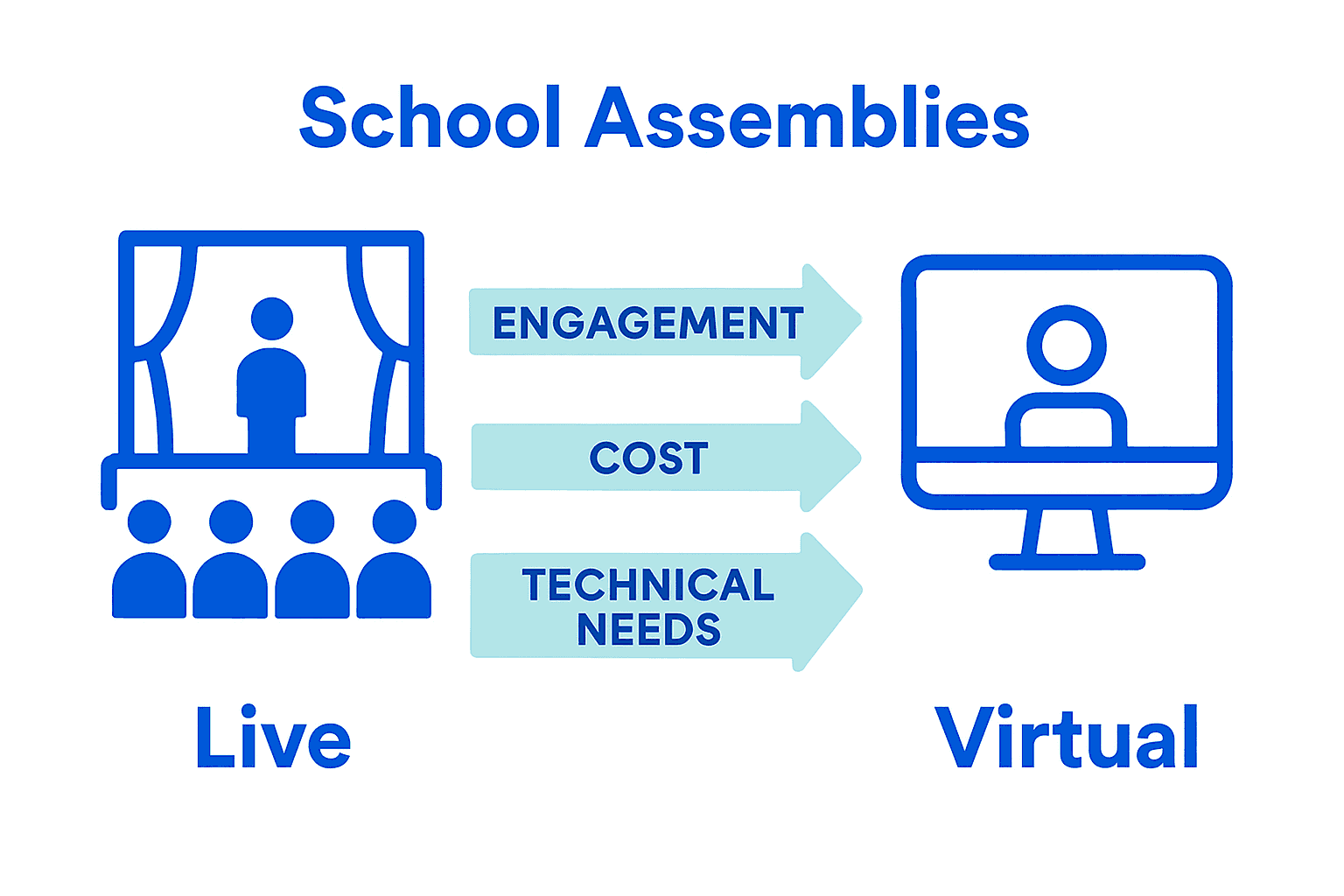
Key differences between live and virtual assembly programs include:
- Engagement Levels: Live assemblies offer direct physical interaction, while virtual programs provide digital accessibility
- Cost Considerations: Virtual assemblies typically reduce travel and logistics expenses
- Technical Requirements: Virtual programs demand reliable internet and appropriate streaming technology
- Flexibility: Digital platforms allow for broader geographic reach and scheduling options
According to The Headteacher, innovative strategies like incorporating video clips and encouraging community participation can enhance both live and virtual assembly experiences. This approach ensures that regardless of the format, student engagement remains paramount.
Virtual or Hybrid Assemblies suggests that the most successful schools are those that view live and virtual formats not as competing options, but as complementary tools in creating dynamic, interactive educational experiences that adapt to diverse learning environments.
Budgeting and Funding School Assemblies
Navigating the financial landscape of school assemblies requires strategic planning and creative funding approaches. Race Towards School Assembly Funding offers critical insights into managing limited educational budgets while delivering high-impact learning experiences.
Schools have multiple funding strategies to consider:
- Grants and Educational Funds: Seek specialized educational grants targeting innovative programming
- PTA/PTO Fundraising: Leverage parent organization support for assembly investments
- Community Sponsorships: Partner with local businesses interested in educational support
- Shared Costs: Collaborate with neighboring schools to distribute assembly expenses
According to ArXiv, innovative approaches like the TARA project demonstrate how schools can implement cost-effective educational experiences. The project showcases how strategic resource allocation can transform limited budgets into rich learning opportunities, with comprehensive open-source resources enabling schools to develop engaging assembly programs at minimal expenses.
Ultimately, successful assembly funding isn’t about spending more—it’s about investing wisely. Schools that approach assembly budgeting as a strategic investment in student engagement and learning will find creative solutions that maximize educational impact while maintaining fiscal responsibility.

How to Choose Reliable Assembly Providers
Selecting the right assembly provider can make the difference between a forgettable presentation and an unforgettable educational experience. Assembly Show Selection Tips for Schools offers crucial guidance for administrators navigating this important decision.
Critical criteria for evaluating assembly providers include:
- Educational Credentials: Verify performers’ backgrounds in education and curriculum development
- Performance Diversity: Assess ability to engage students across different grade levels
- Content Alignment: Ensure presentations match current educational standards
- Interactive Capabilities: Look for programs that encourage student participation
- Technical Flexibility: Confirm providers can deliver both live and virtual experiences
According to The Headteacher, top-tier assembly providers should demonstrate remarkable adaptability, utilizing diverse multimedia approaches and involving various community members to create dynamic, resonant educational experiences.
The Best Way to Evaluate an Assembly Show suggests that schools should view provider selection as a strategic partnership, prioritizing those who can transform standard presentations into meaningful learning opportunities that inspire and engage students.
Affordable and High-Quality School Assemblies Made Easy
Finding budget-friendly school assemblies that do not compromise on quality is a common challenge for educators. This guide highlights the need for curriculum-aligned, interactive, and inspirational experiences that fit within tight school budgets. Schools want to deliver powerful presentations that engage students emotionally and intellectually without overspending or losing impact.
AssemblyShows.com understands this balance perfectly. Led by veteran performer Doug Scheer, we offer 12 dynamic assembly programs designed to blend curriculum goals with high-energy, interactive fun. Whether you prefer engaging live performances or flexible virtual options, our Virtual Shows Archives – Scheer Genius Assembly Shows deliver cost-effective solutions without sacrificing excellence.
Discover how easy it is to bring memorable assemblies to your school by browsing our talented team in the School Assembly Performers Archives – Scheer Genius Assembly Shows. Act now to book a program that inspires students and respects your budget at AssemblyShows.com. Take the next step toward transforming your school assemblies today.
Frequently Asked Questions
What are the key characteristics of a high-quality school assembly?
A high-quality school assembly is characterized by curriculum alignment, interactive engagement, inspirational content, and professional delivery from skilled performers.
How can schools manage budget constraints while organizing assemblies?
Schools can manage budgets by opting for virtual assemblies, collaborating with other schools to share costs, engaging local performers, and negotiating bulk booking discounts for multiple performances.
What are the advantages of live assemblies compared to virtual programs?
Live assemblies offer direct physical interaction and engagement, while virtual programs provide cost savings and broader accessibility, allowing schools to reach students in diverse geographical locations.
How can schools effectively fund their assembly programs?
Schools can effectively fund assembly programs through grants, PTA fundraising, community sponsorships, and by sharing costs with neighboring schools to distribute expenses.
Recommended
- Role of Assemblies for Teachers: Complete Guide – Scheer Genius Assembly Shows
- What is an Elementary School Assembly? Understanding Its Importance – Scheer Genius Assembly Shows
- Role of Curriculum-Based Assemblies: Complete Guide – Scheer Genius Assembly Shows
- 7 Smart What Budget-Friendly Assembly Ideas for 2026 – Scheer Genius Assembly Shows
- How to Plan a Lesson: Easy Steps Any Teacher Can Follow – Vertech Academy
- Success Exhibiting at IFEMA Madrid: The Ultimate Exhibitor Guide