
Nearly 80 percent of students remember science topics better when learning is interactive rather than lecture-based. Hands-on experiments, robotics shows, and coding workshops turn complex STEM ideas into real-world adventures. These engaging activities not only spark curiosity but also help kids build problem-solving skills and discover new career paths while having fun.
Quick Summary
| Takeaway | Explanation |
|---|---|
| 1. Engage students through hands-on experiments. | Hands-on science experiments enhance critical thinking and scientific reasoning by providing tangible learning experiences. |
| 2. Use robotics to inspire curiosity in STEM fields. | Robotics demonstrations capture student imagination and create excitement about technology and engineering opportunities. |
| 3. Transform math learning with magic shows. | Math magic shows present mathematical principles engagingly, helping students overcome anxiety and build confidence. |
| 4. Foster teamwork through engineering challenges. | Team-based engineering activities develop collaboration, communication skills, and innovative problem-solving abilities. |
| 5. Connect students with local STEM professionals. | Career connection assemblies bridge classroom learning and real-world opportunities, providing insights into diverse STEM careers. |
1. Hands-On Science Experiments for Interactive Learning
Science comes alive when students transform from passive observers to active experimenters. Interactive learning through hands-on science experiments creates an engaging educational experience that sparks curiosity and deepens understanding.
Why Hands-On Experiments Matter
Traditional classroom learning often keeps students at a distance from scientific discovery. But when students physically manipulate materials, conduct experiments, and observe results firsthand, they develop critical thinking skills and scientific reasoning that textbooks cannot replicate.
According to the Scientific Magic Tricks kids can do virtually! guide, interactive experiments transform learning from abstract concepts to tangible experiences. Students become scientists exploring the world around them.
Experiment Design Strategies
Effective hands-on science experiments should:
- Align with curriculum standards
- Use readily available materials
- Encourage student collaboration
- Provide clear, measurable outcomes
- Include opportunities for student hypothesis and prediction
Research from the American Museum of Natural History suggests creating experiments that allow students to explore, predict, and reflect. Simple experiments like crystal growing, basic chemical reactions, or plant biology projects can turn a classroom into a vibrant scientific laboratory.
Practical Implementation Tips
Start small. Choose experiments that match student age and skill levels. Provide clear instructions, safety guidelines, and structured observation sheets. Encourage students to document their process, make predictions, and discuss results as a group.
By embracing hands-on science experiments, educators can transform learning from memorization to genuine scientific exploration.
2. Robotics Demonstrations to Spark Student Curiosity
Robotics represents the frontier of technological innovation where imagination meets engineering. School assemblies featuring robotics demonstrations can transform students abstract understanding into tangible excitement about science and technology.
The Power of Robotic Demonstrations
When students witness robots performing complex tasks, they move beyond textbook learning into a world of real world technological possibilities. These demonstrations create powerful moments of wonder that can inspire future engineers, programmers, and innovators.
According to research from the Side-by-Side Science: A Virtual Science Assembly guide, interactive scientific demonstrations are crucial for capturing student imagination. Robotics provides a perfect platform for this engagement.
Strategic Demonstration Approaches
Effective robotics demonstrations should:
- Showcase practical robot applications
- Explain basic programming concepts
- Allow student interaction
- Highlight problem solving capabilities
- Demonstrate robots solving real world challenges
Research from the IEEE Robotics and Automation Society shows that interactive sessions where students can observe and understand robotic mechanisms significantly increase their technological curiosity.
Implementation Strategies
Choose demonstrations that match student age groups. For younger students, focus on simple robot movements and playful interactions. Middle and high school students can explore more complex programming and engineering principles.
Consider inviting local robotics teams or university students to demonstrate cutting edge robotic technologies. These live demonstrations create memorable learning experiences that textbooks cannot replicate.
By integrating robotics demonstrations, schools can transform STEM learning from abstract concepts to exciting technological explorations.
3. Math Magic Shows to Make Numbers Fun
Math is not just about numbers and equations. It is about unlocking the magic hidden within mathematical concepts. Math magic shows transform abstract numerical ideas into exciting, interactive experiences that captivate student imagination.
Reimagining Mathematical Learning
Traditional math education often feels rigid and disconnected from real world excitement. Math magic shows break through these barriers by presenting mathematical principles as mind bending tricks and engaging performances.
As outlined in the Unleash Your Students’ Inner Math Superheroes resource, transforming math into an entertaining experience helps students overcome mathematical anxiety and build confidence.
Key Elements of Successful Math Magic Shows
Effective math magic demonstrations should:
- Use visual and interactive illusions
- Explain mathematical principles behind tricks
- Encourage student participation
- Highlight real world mathematical applications
- Create moments of surprise and wonder
Research from Science Fun For Everyone suggests that interactive mathematical presentations can dramatically improve student engagement and understanding.
Implementation Strategies
Choose magic shows that reveal mathematical principles rather than simply performing tricks. Demonstrate how mathematical reasoning can solve seemingly impossible challenges. Showcase tricks involving probability, geometry, and logical reasoning that surprise and educate simultaneously.
Consider inviting professional math performers who can blend entertainment with educational content. These performers can help students see mathematics as a creative and exciting field of discovery.
By presenting math through magical performances, schools can transform students perception of numbers from intimidating abstractions to fascinating puzzles waiting to be solved.
4. Engineering Challenges for Team Building
Engineering challenges transform classrooms into collaborative laboratories where students discover the power of teamwork and innovation. These interactive experiences go beyond traditional learning by challenging students to solve complex problems together.
The Science of Collaborative Problem Solving
Team based engineering challenges teach students far more than technical skills. They develop critical communication abilities, learn to negotiate ideas, and understand the importance of collective intelligence. When students work together to design solutions, they experience the real world dynamics of professional engineering teams.
The 8 Creative Middle School Assembly Ideas guide highlights how interactive challenges can dramatically enhance student engagement and learning outcomes.
Essential Components of Effective Engineering Challenges
Successful team engineering challenges should:
- Require diverse skill sets
- Have clear but complex objectives
- Provide limited resources
- Encourage creative problem solving
- Include opportunities for reflection and iteration
Research from Science Fun For Everyone demonstrates that hands on engineering challenges significantly improve students collaborative skills and technological understanding.
Practical Implementation Strategies
Design challenges that mirror real world engineering scenarios. For example, ask students to build a structure using limited materials that can withstand specific environmental conditions. Or challenge them to create a simple machine that solves a practical problem.
Ensure that challenges require multiple perspectives. Some students might excel at design, others at calculation, and some at communication. These differences become strengths when students learn to value each team members contributions.
By integrating engineering challenges into school assemblies, educators can transform STEM learning from individual achievement to collaborative discovery.
5. Technology Workshops Featuring Coding Activities
Coding is the language of the digital age. Technology workshops that introduce students to programming transform complex technical skills into exciting learning adventures that prepare them for future careers.
Demystifying Digital Creation
Many students view technology as mysterious and intimidating. Coding workshops break down these barriers by showing how computer programming is essentially creative problem solving. Students discover they can design games, create animations, and develop applications using logical thinking and imagination.
The Side-by-Side Science: A Virtual Science Assembly guide emphasizes the importance of interactive technology experiences in modern education.
Key Elements of Effective Coding Workshops
Successful technology workshops should:
- Use age appropriate programming platforms
- Include hands on project based learning
- Provide immediate visual feedback
- Encourage experimentation
- Celebrate individual creativity
Research from Science Fun For Everyone indicates that interactive coding activities significantly boost students technological confidence and computational thinking skills.
Strategic Implementation Approaches
Start with visual programming languages like Scratch that allow students to create interactive stories and games through drag and drop interfaces. As students gain confidence, gradually introduce more complex coding languages.
Create supportive environments where mistakes are viewed as learning opportunities. Coding is about iteration and continuous improvement. Encourage students to experiment, debug their own code, and understand that problem solving is an essential skill.
By integrating technology workshops, schools can help students transform from technology consumers to innovative digital creators.
6. Environmental STEM Assemblies for Real-World Impact
Environmental science transforms abstract global challenges into tangible learning experiences that empower students to become responsible global citizens. These assemblies bridge classroom theory with real world environmental solutions.
Connecting Science to Global Challenges
Today’s students are tomorrow’s environmental problem solvers. By presenting environmental science as an actionable discipline, schools can inspire students to understand complex ecological systems and develop innovative solutions to pressing environmental challenges.
As outlined in the Understanding STEM Assembly Programs guide, interactive experiences are crucial for meaningful scientific learning.
Key Elements of Effective Environmental STEM Assemblies
Impactful environmental science assemblies should:
- Demonstrate human environmental interactions
- Showcase local and global ecological challenges
- Provide practical sustainability strategies
- Use interactive demonstration techniques
- Encourage student critical thinking
Research from the Smithsonian Science Education Center highlights the importance of connecting scientific concepts to real world scenarios students can understand and act upon.
Strategic Implementation Approaches
Focus on age appropriate environmental topics. For younger students, explore local ecosystem interactions. For older students, delve into complex global environmental challenges like climate change, biodiversity preservation, and sustainable resource management.
Use compelling visual demonstrations that show environmental science in action. Illustrate how individual choices impact larger ecological systems. Help students understand they can be agents of positive environmental change.
By integrating environmental STEM assemblies, schools can transform scientific learning from passive observation to active global citizenship.
7. Career Connections: Meet Local STEM Professionals
Career exploration transforms abstract academic learning into tangible professional pathways. By connecting students directly with local STEM professionals, schools can inspire future innovators and bridge the gap between classroom education and real world opportunities.
Demystifying Professional Journeys
Many students struggle to understand how classroom learning translates into exciting career opportunities. Direct interactions with STEM professionals reveal the diverse and dynamic nature of scientific and technological careers, helping students visualize their potential future paths.
The What is STEM Education? Understanding Its Importance guide emphasizes the critical role of connecting education with professional experiences.
Key Components of Successful Career Connection Assemblies
Effective professional connection sessions should:
- Feature diverse STEM professionals
- Highlight multiple career pathways
- Include interactive Q and A segments
- Share personal career journey stories
- Provide realistic career insights
Research from the IEEE Robotics and Automation Society demonstrates that direct professional interactions significantly increase student interest and engagement in STEM fields.
Strategic Implementation Approaches
Invite professionals from various sectors local engineering firms, research laboratories, technology companies, and educational institutions. Encourage speakers to share not just their professional achievements but also their personal challenges and learning experiences.
Structure sessions to be interactive. Allow students to ask questions, hear personal stories, and understand the human side of scientific and technological careers. Help students see professionals as approachable mentors rather than distant experts.
By creating meaningful career connection assemblies, schools can transform student perceptions of STEM from abstract subjects to exciting professional opportunities.
Below is a comprehensive table summarizing various interactive STEM educational strategies discussed in the article.
| Activity Type | Key Elements | Implementation Strategies | Expected Outcomes |
|---|---|---|---|
| Hands-On Science Experiments | Align with curriculum, use simple materials, collaboration | Start small, clear instructions, safety guidelines | Enhance critical thinking, deepen understanding |
| Robotics Demonstrations | Practical applications, basic programming, student interaction | Invite local teams, focus on age-appropriate complexity | Inspire future engineers, increase technological curiosity |
| Math Magic Shows | Interactive illusions, math principles behind tricks, participation | Use professional performers, reveal principles | Reduce anxiety, boost confidence, enhance engagement |
| Engineering Challenges | Diverse skill sets, limited resources, team collaboration | Design real-world scenarios, encourage multiple perspectives | Improve communication skills, foster innovation |
| Coding Workshops | Visual programming, project-based learning, instant feedback | Begin with Scratch, create supportive environment | Boost computational skills, inspire digital creativity |
| Environmental STEM Assemblies | Human-environment interactions, sustainability strategies | Focus on age-appropriate topics, use visual demonstrations | Inspire environmental activism, foster critical thinking |
| Career Connections | Diverse professionals, career stories, interactive Q&A | Invite local STEM professionals, structure interactive sessions | Connect learning with career paths, increase engagement |
Transform Your STEM Learning with Engaging Assembly Shows
Are you ready to overcome the challenge of making STEM concepts come alive for your students? This article highlights the need for hands-on science experiments, robotics demonstrations, math magic shows, and more to spark curiosity and foster interactive learning. At AssemblyShows.com, we understand how critical it is to turn abstract scientific ideas into exciting, memorable experiences that boost student engagement and confidence.
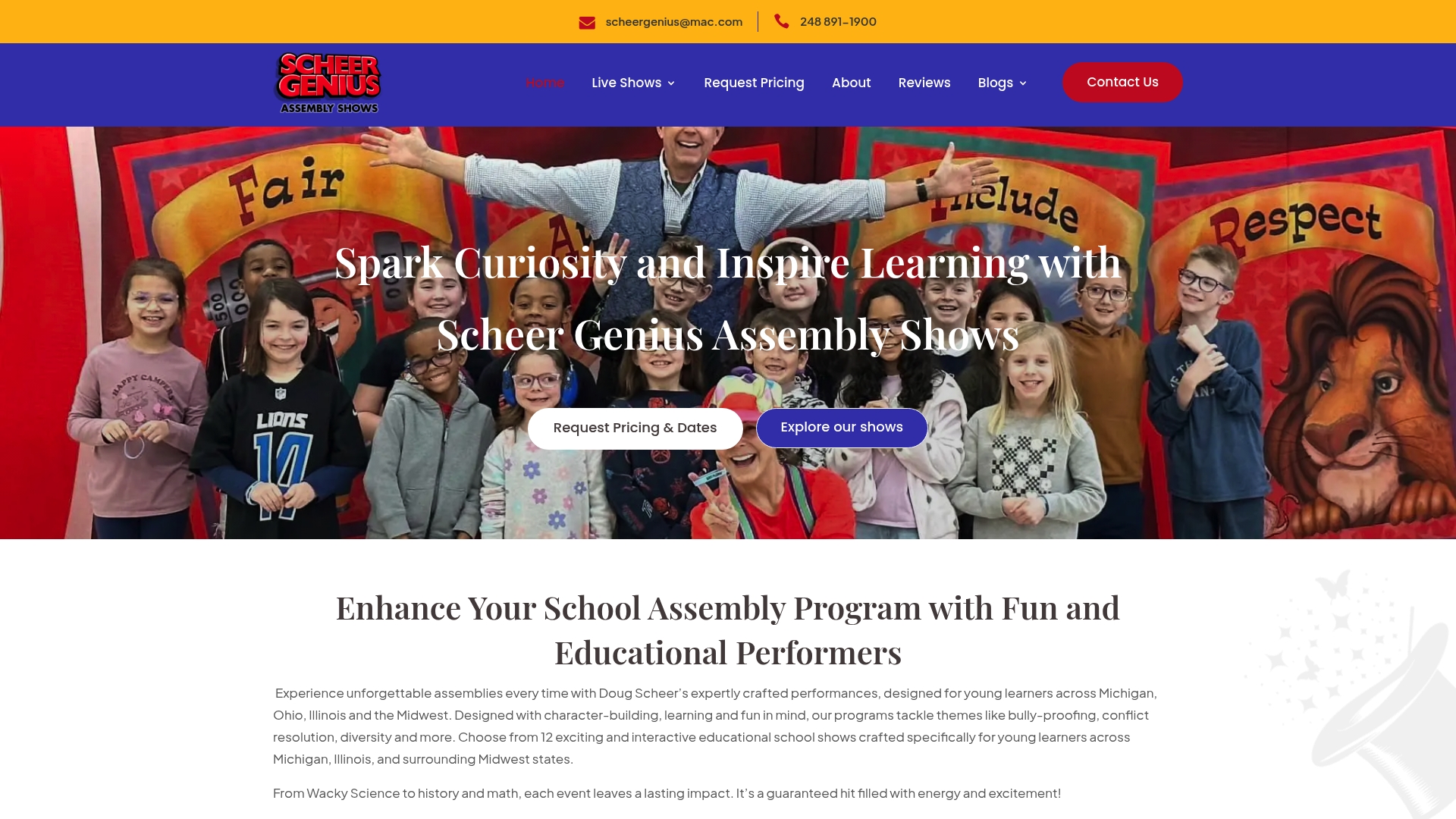
Discover a variety of curriculum-aligned programs led by veteran performer Doug Scheer designed specifically to ignite young minds across Michigan, Ohio, Illinois, and the Midwest. From live assemblies to interactive virtual experiences, our shows turn teamwork, technology workshops, and career connections into thrilling learning moments that your students will love. Explore our full range of inspiring options in the Assemblies Archives and find virtual presentations in our Virtual Shows Archives. Visit AssemblyShows.com today to book a program that brings STEM to life now and empowers your students to become curious creators and problem solvers.
Frequently Asked Questions
How can hands-on science experiments improve student engagement in STEM learning?
Hands-on science experiments actively involve students in the learning process, making abstract concepts tangible. Foster engagement by starting with simple experiments related to your curriculum that allow students to predict and reflect on results.
What steps should I take to implement robotics demonstrations in my school?
To implement robotics demonstrations, begin by selecting age-appropriate materials and outline the learning objectives. Collaborate with local robotics teams or educators to create engaging, interactive sessions that stimulate student curiosity and understanding.
How can math magic shows benefit students who struggle with math?
Math magic shows can transform students’ perceptions of math from intimidating to fun by presenting mathematical concepts as engaging performances. Organize a show focusing on real-world applications of math to encourage participation and reduce anxiety around the subject.
What are effective team-building engineering challenges for students?
Effective engineering challenges should involve collaboration, creativity, and clear objectives. Design tasks that require students to use diverse skill sets, ensuring they reflect real-world engineering scenarios to foster teamwork and problem-solving skills.
How can technology workshops make coding more appealing to students?
Technology workshops can make coding approachable by utilizing visual programming platforms that simplify coding concepts. Start with beginner-friendly languages that allow students to create projects, fostering a sense of accomplishment and encouraging further exploration.
What strategies can I use to connect students with local STEM professionals?
To connect students with local STEM professionals, organize assemblies where these individuals can share their career journeys and experiences. Ensure the sessions are interactive by including Q&A segments, allowing students to ask questions and engage in conversations about potential career paths.
Recommended
- Understanding Stem Assembly Programs Explained – Scheer Genius Assembly Shows
- 8 Creative Middle School Assembly Ideas to Engage Students – Scheer Genius Assembly Shows
- 8 Fun Elementary School Assembly Ideas for Engaging Students – Scheer Genius Assembly Shows
- 7 Essential Interactive Assembly Tips for Schools – Scheer Genius Assembly Shows